So you know the old adage "the best way to learn is to teach"? Well, that is the main purpose of what I am about to write. Bottom line is, I don't know jaegers very well, and I needed to force myself to get back up to speed (as much as a landlocked birder can anyway) in order to say anything intelligible on the recent jaeger sp. at Holland MI.
[To let the cat out of the bag: I am now confident this is a PAJA, but intially suspected LTJA.]
So on Friday September 20th, I received a call from Curtis Dykstra that a darkish juvenile jaeger was sitting on the
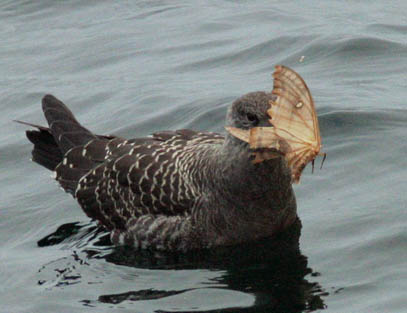
beach at Holland SP, and that it had rounded central rectrices. I even received this photo (copyright Judy Manning) confirming this, in addition to the testimonies of multiple people standing at close range with scopes:
This photo shows clearly rounded central rectrices (=rectrix 1, aka. 'R1'). [Aside: the bird actually only has one of its two R1s, (see below)]. I mean, does anyone looking at this photo think the R1s are pointed? (but seen the detailed analysis below). So, according to my understanding, this eliminated a juvenile Parasitic Jaeger (PAJA) from the picture, securing the bird as either Long-tailed (LTJA) or Pomarine (POJA), both of which are state birds for me. So the 1.5 hour one way chase was on. Here are my photos from my 2 hour visit, with my full ID analysis embedded in no particular order:
The bird was amazingly tame, clearly with some kind of sickness/disease, including feather loss around the vent area, though when it flew its demeanor was active and strong.

The color of the scapular/mantle/wing covert edgings has been a source of some contention. Let's break it down. These feathers were edged in a yellow or blonde cast, lacking orange or rufous tones. Visitors the following day commented that these feathers were in fact 'buffy' or 'warm' toned (I will grant them buffy, just not rufous), and hinted that this favored PAJA over LTJA. I studied this bird from 20 feet for 2 hours (in overcast conditions), and can attest that although some of the marginal/lesser wing coverts had an oranger cast, the scapulars/mantle/grater coverts/tertials/primary tips did not have the warm cast of the 'classic' rufousy PAJAs, and I still contend this bird is not out of range for LTJA. So I count this field mark as a wash (ie. between PAJA and LTJA). Here is one example of a LTJA with even warmer edgings than this bird:
http://www.philjeffrey.net/118_1882m.jpg
Now note the 'messiness/jaggedness' of the uppertail covert edgings, lacking the evenly, cleanly, barred look more typical of Long-tailed.
Here is Pyle's treatment of uppertail coverts in juvenile jaegers, this bird clearly matching PAJA and being wrong for LTJA or POJA.
One oft-cited field mark for pale juvenile Long-taileds, is that the lower breast contrasts paler than the thin, dark breast band above it. This bird appears better for Parasitic here, with the breast band extending down into the upper belly:
Compare to
this juv LTJA from Oregon, which shows the typical pattern of a thinner breast band not extending this far down.
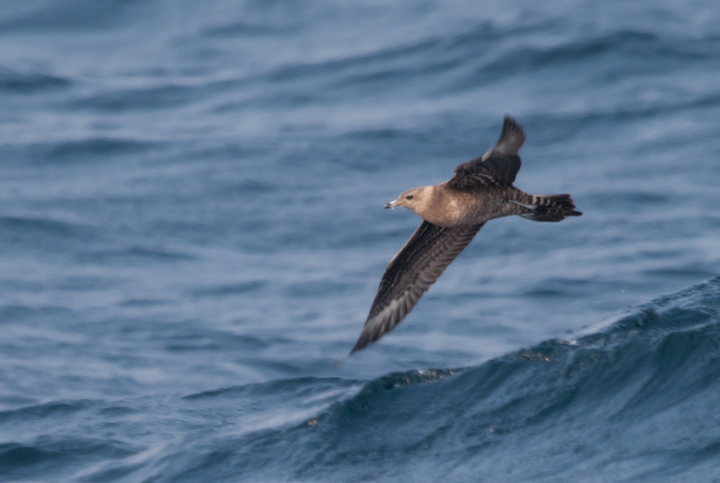
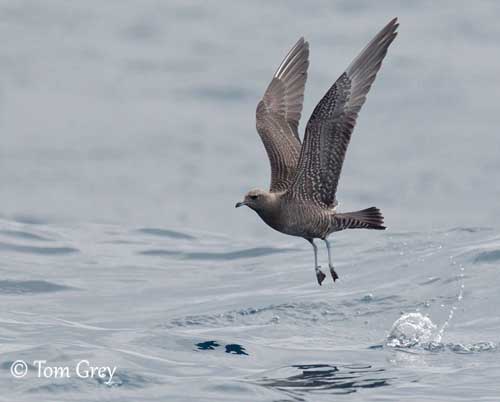
One field mark immediately pointed out by Tim Baerwald (among many others; Tim correctly ID'ed this bird immediately PAJA, and I greatly appreciate his input) was the bird's short-tailed appearance. I am not talking about R1, but about the amount of bird behind the trailing edge of the wing, without reference to R1 extension. Compare my next two photos to the, lengthy, attenuated rear end of
this obvious juvenile Long-tailed.
Also note how the Holland jaeger carries the weight throughout the belly evenly, rather than in the chest, like LTJA does. Here are some LTJAs for comparison,
BIRD 1,
BIRD 2,
BIRD 3.
and Kaufman's illustration of these traits:
This trait really is notibeable and very useful for ID if seen well, at least on many individuals. Another way of putting this is that the Holland bird's wings are wider than the amount of bird behind them, as visible here:
I really believe that given good views, that these two traits can be accurately judged on most or all individuals, given sufficient looks. And both of these heavily favor PAJA on the Holland bird. As of the time of my field observation I was not aware of how to apply these traits.
As others have noted, the uppertail and undertail coverts were messily barred (not the neat, straight, stripes more typical of LTJA and POJA), and they had a cinnamon background color. Many have commented that this color is suggestive (even diagnostic?) of PAJA. I am not positive whether this is diagnostic, but it does favor PAJA. If LTJA can show this color, I have not found any evidence it can (someone please let me know of photos of such birds)
The face had streaking and a pale blonde/yellowish nape, the same blonde cast as the upperpart fringing.
The feet and legs were mixed blue-gray and black, with the black limited to the distal half of the feet. Pyle shows that in PAJA and POJA, this heavily favors a hatching-year (juvenile of 2013) bird. He says nothing for LTJA however.

The bird was much smaller than Herring Gulls. POJA is basically the wingspan of Ring-billed Gull, PAJA like Laughing Gull, and LTJA like Black-legged Kittiwake. So I am not sure this helps too much.
Looking very closely at the tip of the first rectrix (R1), it appeared rounded from every angle I could view it, which was not surprising considering the photo from Judy Manning:
And here is my best shot of this feather:
I say feather, since it is clear by looking at the translucence of the second rectrices, that there is only one R1 feather, the other being broken or missing. Thanks to Chip Francke for picking up on this in the field. Now how to interpret this feather shape. Here are the illustrations from Pyle (Identification Guide to North American Birds, Part II) and Kaufman (Advanced Birding). First, juveniles of the three species together in Pyle:
And Kaufman's illustration of all three juveniles:
Here are Pyle's illustrations for PAJA only (by age; juveniles [=HY] at the left, A and B):
And POJA (juveniles also at the left; A and B)
Pyle does not give such a figure for LTJA.
Finally, here is the R1 of the Holland jaeger after it was found dead, taken in-hand:
I think it is abundantly clear that the Holland bird has an R1 shape that does not perfectly match any of the illustrations in my references, or at least it is not clear what is the closest match. There is a SLIGHT point on the feather, but this is only seen clearly in the hand, and it totally contradicts the field observations and in life photos of the bird in which this feather always appeared rounded (see above). And I would call this a very bluntly pointed feather tip. (Aside: the Collins Guide to Birds of Europe refers to the R1 of juv.LTJA as "bluntly pointed"; well which is it? pointed or blunt?).
Here is my best interpretation of this field mark for the Holland bird. First, if you were to judge this bird by Kaufman's illustration, you would have to say it best matches the shape of LTJA. If you judge it by Pyle's illustration, it is close to choice C in Fig. 519 (PAJA), but not as pointy. It more closely matches choices E or F in Fig. 519, which are LTJA. Also note how Kaufman illustrates juv. POJA as having slight pointed tips at the rachis, but in that instance the feather appears rectangular and flat-tipped, but with the slight point. I don't think that is a good match for our bird.
Another thing which hasn't yet been mentioned, is that there is no guarantee this feather is juvenal. If in fact the juvenal feather was lost (perhaps with the other R1 in whatever incident caused it to lose the first one), and this is in fact formative (vernacular: "first winter"), then it is a very close match to choice C in Fig. 517 (POJA!). Since Pyle doesn't illustrate R1s in LTJA across ages, I am not sure whether this bird also matches that species in formative plumage. Clearly, this field mark is greatly oversimplified by field guides, and it needs to be applied extremely gingerly!
The take home for me is as follows (though as stated earlier, all of this is subject to correction and I welcome everyone's thoughts on where I am getting it wrong):
1) jaeger R1 tip shapes are a morass of variability which are oversimplified by the literature.
2) obviously pointed R1s, as long as one is CERTAIN that they are juvenal feathers and not formative feathers, do appear to heavily favor PAJA (presumably diagnostic, but who knows?)
3) slightly pointed R1s like in the Holland bird are not distinguishable from truly rounded ones under normal field conditions, even in photographs (!!)
4) b/c of #3, rounded-appearing juv. R1s are **NOT USEFUL** for identification of juvenile jaegers!
Item 4 is a total revelation for me. I have always thought that a good look is plenty to establish a rounded R1, and that this was diagnostic of either LTJA or POJA, but I no longer believe it. I even wonder if this field mark has any value? If anyone takes issue with this conclusion, please post your comment below. I love being proved wrong, as I think it is where the most progress in birding is made. All I care about here is getting the ID right, not being right up front.
Another point I want to bring home is that the Holland bird's R1 was not worn or abraded, as postulated by some to explain how a PAJA could show this. The barbs were quite fresh.
Now let's get to the issue of bill proportions. Here is how Kaufman illustrates this (apparently diagnostic?) trait:
The caption is self-explanatory. Here is my analysis of this trait on the Holland bird. Note that the distribution of black on the nail is much less than the actual nail itself! (very important detail!) One must use the anatomy, not the pigmentation, to accurately measure this trait. From the in-hand photo of the specimen and my best in life shot. The # of pixels between each line was measured in photoshop and an exact ratio calculated:

The ratio appears to be about 44-45%, as calculated by using the pixel measuring tool in Photoshop. Here is an overlay of the Kaufman figure with both shots.
My judgment of this trait is that the Holland bird is closest to LTJA, but that it may be inermediate and not helpful for ID. But at the very least I would argue that this trait does not favor PAJA. Some have also mentioned the position of the gonys (the angle on the lower mandible) is supportive of PAJA, but compare it to Kaufman's illustration. If anything this also seems to either favor LTJA or perhaps be intermediate. Since I believe the Holland bird to be a PAJA, the take home would be:
1) nail to bill ratios are variable, not static, as illustrated (there is apparently some age-related variation as well, see Pyle)
2) this field mark is supporting, never diagnostic (except perhaps at the extremes?)
3) the Holland bird's bill ratio is indeterminate, but not inconsistent with LTJA
I think that's enough for a first volley! I am comfortable calling this bird a juv. PAJA on the LTJA end of the spectrum. So far, no measurements or DNA analysis have been reported from the specimen. Hopefully we will get this confirmation at some point. I look forward to alternate views (corrections?) to those I've put forth, and I want to thank Curtis Dykstra, Carl and Judy Manning, Mike and Jeremy Overway for finding the bird and spreading the word, to Tim Baerwald for his quick correction and detailed laundry list of field marks supporting PAJA (extremely helpful), Josh Kamp and Marc North for asking why this wasn't a PAJA, and Adam Byrne, Brad Murphy, Scott Terry, and Joe Kaplan for their detailed analyses of this very instructive bird.
PS. here are the in-hand shots I later received of the specimen