Total Pageviews

Friday, March 2, 2012

A test of my DSLR UV filter


Being a beginner at photography, I have realized what a slow learning curve this process involves. I've been methodically trying to isolate the cause of my constant lack of crispness. Even in comparison to my friends who are shooting identical lenses and bodies, I seem to be unable to match the clarity of the shots I respect the most. I have considered the possible causes
one by one: motion blur, depth of focus/f stop, shutter speed too slow. Though I have made some definite progress, I still have never been particularly happy with my results.


Up until now I hadn't considered the possible effect my UV filter might have been having on my image quality. On a whim, I decided to take 2 identical photos of the same bird, back to back, one with the filter on then off. Settings were entirely manual, so no difference there, and although I cropped the images (identically), there was no other manipulation of the files, and here were my results:


With filter:


Without filter:

Here are the same shots even more cropped:
With filter:
Without filter:

I was SHOCKED to say the least. But could this have been due to motion blur on former but not the latter? Or some other cause?

To get to the bottom of this issue, I decided to test it out on a large sample of conditions and subjects. To start, I used the rain hood on all exposures, I mounted the camera/lens setup on my tripod out of the wind, and used the 2 second shutter delay to guarantee the mount wasn't shaking. [I did leave image stabilization on, and now realize I should have shut it off, but the setup was so still I don't think it skewed my results at all.] Settings were entirely manual, and I used center point only autofocus, in each case taking care to put a singular subject right in the dead center of the field and verify that it was in focus before shooting. Here are the results.

First subject: owl box at about 25 feet from camera
Original with filter:
Original without filter:

Here are the same images, cropped equally and kept at 100% resolution jpgs (ie. not resized):

With filter:
And without filter:

Second subject: Red-tailed Hawk against backlit sky, about 250 feet from the camera:

Original with filter:
And original without filter:
Cropped with filter:
Cropped without filter:

And heavily cropped with:

Heavily cropped without:

Subject 3: Suet feeder from 30 feet
Original with filter:

Original without filter:
Cropped with filter:
Cropped without filter:

Subject 5: House Sparrow from 35 feet:
Cropped with filter:
Cropped without filter:
Heavily cropped with:
Heavily cropped without:

Subject 5: Honda Civic from 50 feet:
Cropped with filter:


Cropped without filter:
Subject 6:
Sign from 100 feet:
Cropped significantly, with filter:

Cropped significantly, without filter:

Subject 7: Mute Swans at 1,000 feet
Cropped with filter:

Cropped without filter:
Subject 8: bluebird house nail mount at 15 feet
Cropped slightly with filter:
Cropped slightly without filter:
Needless to say, this seals the deal for me. This filter is clearly damaging the crispness of my images, more so at long range and with increased cropping. But since I am not trying to print or sell photos, just to document rare birds, often at range, it just isn't working for me. The filter is a Promaster 77mm UV filter, and was admittedly the cheapest option I had, something like $20-30. I bought it only to protect the actual camera lens from being struck by branches or any hard object it comes into contact with. So clearly I am going to have to find a better solution to this problem.

I do secure the rain sleeve in the out position at all times, and perhaps this is enough to protect the lens under most circumstances? I would really appreciate the opinions of other photographers as to whether I should try to buy a more expensive filter, or if there is some other option for protecting my lens and leaving the filter off.


Sunday, February 19, 2012

Solving the riddle of the raven

No, that title is not some poetic reference (I am not well-rounded enough to have such things at my fingertips). Rather than quoth the raven, I just want to know where she lives.

OK, so on March 15, 2009 (http://ebird.org/ebird/view/checklist?subID=S6392013), I was hiking in the Rogue River SGA when I heard a Common Raven in flight deep within the Game Area. I tried to call it in, but never saw the bird. Then on August 7, 2010 (http://ebird.org/ebird/view/checklist?subID=S6734087)as I drove Red Pine Dr. through the Game Area on a hot summer afternoon, I encountered a silent Common Raven flying right over my car, along the roadside. This one never called, and despite my many playback attempts never came back to check me out.

These two happenstance encounters have proved to be my only sightings of this rare species for Kent County. The timing of it all really made me believe that these birds are likely to be breeding somewhere in the Game Area, and were not transient non-breeding visitors, but despite some effort hiking the remote areas of the Game Area for Northern Goshawk surveys, I have never been able to nail down their location, or that of a potential nest.

Fast forward to today. The clear skies really helped build up some quality thermals by noon, and so I decided to spend a little time at Fisk Knob, the highest point in Kent County, to see what raptors might be riding them. Fisk Knob is about 3 miles due NE of the NE corner of the Rogue River SGA, and offers a complete panoramic view of the south horizon, including the skies above the SGA. Pretty quickly into my survey I spotted a Bald Eagle about a mile to my south, heading west. I lost him for a while, then respotted the bird when it was more like 2.5-3 miles to my southwest, much farther out in the heat haze, but rather high up. It was being mobbed (or attended in its thermal?) by two other birds: the first was obviously an American Crow, and the 2nd bird, clearly intermediate in size between the two. I assumed it was going to be a Red-tailed Hawk, but was shocked up putting the scope on it to see that it was indeed a Common Raven! http://ebird.org/ebird/view/checklist?subID=S9904738 The bird was actively soaring (ravens love this), and had an obviously wedge-shaped tail and much thinner wing proportions than the crow. It harassed the eagle briefly, then worked its way south steadily.

I got one crappy video of the bird by digiscoping with my point and shoot, which is here:
But this isn't going to do much other than show a large black bird. I eventually lost the bird to the south of its initial position, as it headed further south.

So, to me, this is a pretty clear indication of local breeding and presumed resident pair of Common Ravens, somewhere in or near Rogue River SGA. I spent the remainder of the afternoon driving the roads I thought the bird to have been soaring above, but predictably came up empty-handed. Man I want to solve this riddle and find out where these things are nesting (they are early nesters, starting as early as January I believe, so chances are they're on eggs as we speak).

Here is the current status of my estimate as to where this territory might lie. First, I estimate the bird to have been at least 3 miles from my position at Fisk Knob when I took the video. I actually scoped Fisk Knob from Albrecht and 20 Mile, a distance of 2.5 miles, and based on the heat distortion estimated that the bird was farther than 2.5 miles from Fisk Knob when I saw it. Here is what 3 miles from Fisk Knob looks like:
The N-S road just east of the endpoint is Albrecht Rd. Now combining the approximate vectors of my sightings (ie. just north of due SW at its northmost, and to a point well south of SW at its southmost) with the ~3 mile distance gives:And finally, given that my hunch is that the bird was possibly upwards of 4-5 miles (estimating distances up there is extremely difficult!), I added this green area. The heavily forested sections of both the red and green polygons, and to their west, is the Rogue River SGA. Indeed, here are the locations of my 2 prior sightings in relation to the polygons from today:So, who's going to be the one who solves this riddle? Birding is all a big game of puzzles, in my opinion. Ravens have a home range of 5-40 km squared according to one source I have. This is 1.5 - 15 square miles, depending on the available resources in the territory and competition from other ravens. This is the extreme southern limit of the range of this species in Michigan, so competition shouldn't be heavy, but perhaps resources are more limited here than in the northern haunts. In any event, these birds are quiet around the nest and likely to be moving around a lot, so detecting the 1 Raven in this area which isn't sitting on a nest is not a trivial task! I will be trying hard to nail down this bird and get a good photo once and for all.

Since almost all of the other listers in Kent County still need this species, I am sure they are cheering for me.

_____________________________________________________________________
Postscript (added Feb 20): Additional research has now led me to the conclusion that this species was last documented nesting in the southern lower peninsula on March 18, 1890, in Almena Twp., Van Buren County (Barrows 1912, p. 418 [Michigan Bird Life]) by "Mr. Sikes", of a nest 60 t up in a broken sycamore top containing 2 small, noisy, youngsters. This location is somewhere within a swamp several miles long and 2 miles wide, along the N. Branch of the Paw Paw River, so likely here, just north of the current day Wolf Lake Fish Hatchery:
Anyway, the point is that according to both the first and second breeding bird atlas accounts, this species does not seem to have any territories south of the tension zone, or more specifically, south of Newaygo, Mecosta, Oceana and Midland Counties: Co. http://www.mibirdatlas.org/Portals/12/MBA2010/CORAaccount.pdf
If there is a nesting pair of ravens in Rogue River SGA, they will be the first documented nesting pair for the southern lower peninsula in about 122 years! Needless to say, my motivation to document a nest is rather large now. More soon....

Saturday, February 4, 2012

Hoary time

On December 6, 2007, several years before I became interested in Kent County listing, I received a call from a friend who had a frosty adult male Hoary Redpoll in with 200 Commons about 10 minutes away. I rushed over to the scene just to see a rare bird, only to find that only 75 redpolls remained, not including the one I was looking for. I searched for several days and never saw more than 75 birds nor the Hoary.

A similar scene played out at the DeBruine residence in eastern Kent Co. yesterday, and was even more painful now that I am interested in the species for my county list. Minutes before I arrived, the flock of 120 Commons with 2+ candidates for Hoary departed, and only 50-60 Commons remained. Oh, the agony. I assumed the flock of over 100 would never return, but was pleasantly surprised by the appearance today of about 200 Commons (many thanks to the DeBruine family for their amazing hospitality and birding ardor- there are a LOT of birders in that household!). Upon arrival today at about 11:15AM I was treated to two very good Hoary Redpoll candidates. Let's get right to the field marks:

Individual 1. This bird, like the other, was extremely frosty white, and stood out amongst the Commons very clearly, at distance, by naked eye. Neither bird had red on the breast/underparts, making them both NOT adult males, I believe. The flank streaking on bird 1 was very sparse and fine, quite delicate (and beautiful!). Its undertail coverts had but one streak on the longest coverts, and its upperparts and crown were very frosty white. The uppertail coverts and rump were not seen. Like the second bird, its bill was small, nasal tuft large, and the bird had a small red cap and bull-headed appearance. This changed with angle somewhat:
Frosty upperparts and single undertail covert streak:
Bird 2 was similarly frosty to the first bird, and stood out naked eye just as much as bird 1. This bird was more streaky on the flanks (immature female?), but was very frosty overall, especially on the scapulars, mantle, and crown. Its rump was completely white and unstreaked (pics below), the undertail coverts again had 1 streak on the longest feathers, and it had an even more pronounced bull-headed appearance. This is shown well in my photographs:
Rump looked like a white sugarcube:
This photo shows how well the bird stood out from the many Common Redpolls.
The nasal tufts were prounced, giving it the bull-headed appearance:
Frosty upperparts and single undertail covert streak:

In terms of grading these 2 birds using Sibley's index I scored these birds like this:

Bird 1
Undertail: 5
Flanks: 5
Rump: not seen
Score: Tough with rump not being seen, but rump was presumably not 1-3, making the total score at least 14. Sibley mentions that for female/immatures, 11 would be enough to qualify as Hoary, so even if it had a 1 (the lowest value), it would still be so.

Bird 2
Undertail: 5
Flanks: 4
Uppertail: 5
Score: 14
Sibley says no female/immatures scored higher than 13, so presumably I have incorrectly assigned these values, but since 11 is enough to make it a Hoary, I believe this ID is fairly conservative.

What a fun and strange winter it is! Over 50 degrees, in shorts, and have seen a Hoary Redpoll all in the same day.

Friday, January 20, 2012

Learning DSLR photography

So, I recently acquired a Canon 60D, a 300mm f/4 IS Canon lens, and 1.4 converter. However, I had basically no idea how to use it when I got it. Goal was to learn as quickly as possible, and to get to a point where I have a really nice backlog of copyright free materials at my disposal, and perhaps to start scoring some nice flight shots of birds unlike anything I could do with digiscoping gear.

I am still quite terrible, but I have made enough mistakes that I am beginning to get it, I think. When I was shooting the Purple Sandpiper in a previous post, I was forced to use f5.6 (the largest aperture possible with the 1.4 converter) because of the low light conditions. Little dd I realize that a bird at the close extreme of my focal distance, that the face and wing would not ever be in focus together. Will try not to make that mistake again next time! Perhaps I should have removed the converter and attempted a smaller aperture to allow a greater depth of field and still accomodate a good shutter speed at such low light?

Here are a few shots I have taken recently which are getting slightly better, though I still find myself unhappy with essentially every shot that comes off my memory card. This is going to be a long process!

White-breasted Nuthatch, one of my favorites I've taken yet:
Rare wintering White-throated Sparrow at Richmond Park in Grand Rapids
Black-capped Chickadee (VERY tough to photograph!)
Red-tailed Hawk
I find photography extremely difficult. Perhaps I am not alone?

Monday, January 9, 2012

Finches

It has been quite amazing to see that White-winged Crossbills seem to invade the south every winter now, at least in small numbers. They have done so each winter since 2008/2009 when we had the largest invasion in recent decades. While searching for Red Crossbill at local cemeteries this weekend I had what I am almost sure was a Type 1 or Type 2 Red Crossbill fly over, giving the 'toop' call rather than the standard 'tik-tik'. It gave the note 3 times spaced out by 2 seconds+ each time, then was never heard again. It did not land, apparently. Here is the checklist for that day:

http://ebird.org/ebird/view/checklist?subID=S9539984

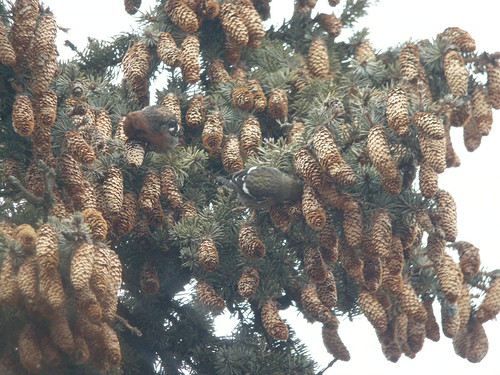
So today I returned to check if the putative Red Crossbill might put in another appearance. It didn't, though Randy Vandermolen and I were able to score some awesome closeup experience with a flock of 6 White-winged Crossbills. They clearly preferred the smaller spruce cones (not sure of species, but the cones were 1/3 the length of Norway Spruce cones). Enjoy:

White-winged Crossbills, Elmwood Cemetery, Cedar Springs, MI, January 9, 2012White-winged Crossbills, Elmwood Cemetery, Cedar Springs, MI, January 9, 2012

And finally, here is the checklist from today:
http://ebird.org/ebird/view/checklist?subID=S9544943

and a hugely valuable resource for those of us wanting to learn the differing vocalizations, bill sizes, and tree preferences of the various types of Red Crossbills:

http://research.amnh.org/vz/ornithology/crossbills/diagnosis.html

Saturday, January 7, 2012

It's NOT a misnomer after all

There aren't too many occasions where a relatively common species that I know well produces a revelation. But not only did this happen to me today, it also happened to a compadre of mine with me at the time. Someone sporting a roughly equal resume of bird experience and study.

Let's back up for a second. Ever wonder why Red-bellied Woodpeckers are named as such? Why aren't they called Red-crowned Woodpecker? You not only never see red underneath, and the first thing you notice when you see the bird is the red on the top of the head. So what gives? The answer has to do with the fact that the folks who named them didn't observe them in the field so much as in the museum drawer. And in the museum drawer, birds are laid out on their backs, so that the belly of the bird is what you see when you open the tray. Sure enough, Red-bellied Woodpeckers do have a red belly patch, but it is not something you'll ever see in the field unless you go way out of your way to look for it. There are plenty of other species for which I've always considered the common name to be a misnomer or at least a strange choice, including: Ring-necked Duck (how about Ring-billed Duck?), Blue-winged Warbler (c'mon, there is no blue there), Orange-crowned Warbler (who ever really sees the orange?), Purple Finch (Rose Finch?), etc.

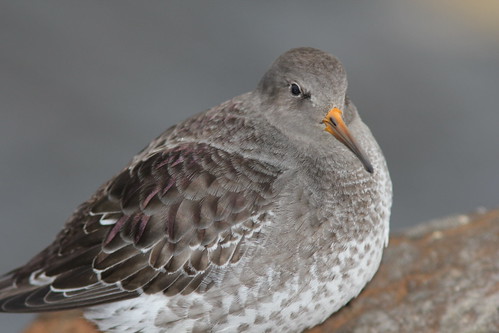
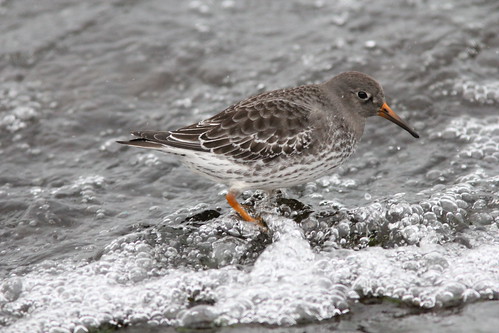
So another bird I'd always considered a member of this list was Purple Sandpiper. Despite the cool name, all of my efforts to establish that "surely this name must have some merit: there must be SOME purple somewhere on this bird" were unsuccessful. Furthermore, I've never even heard anybody say to me that it actually does have it. So it was with a fairly great shock that I looked at my fresh closeup photos of 7 Purple Sandpipers at Pere Marquette Park in Muskegon MI only to see a fairly bright purple iridescence!! Exhibit:

Purple Sandpiper, Muskegon MI, January 7, 2011
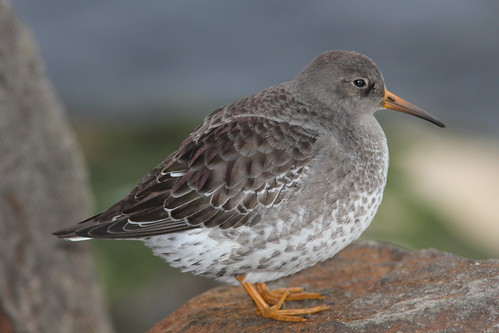
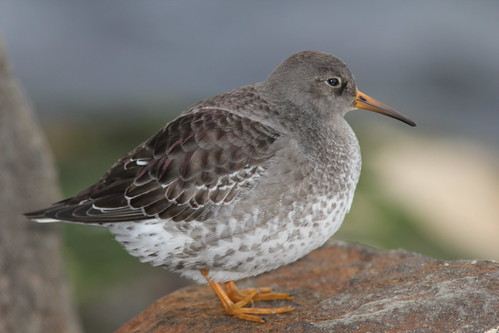
And that ain't no pseudo-purple. That is the real deal. Yes, it is clearly an iridescence as opposed to a pigmentation, but wow! Skye and I were totally blown away by this. The coloration is visible on at least the tertials, scapulars, mantle, proximal wing coverts, and even on the crown (!). Here are the other best views of this:

Purple Sandpiper, Muskegon MI, January 7, 2011

Purple Sandpiper, Muskegon MI, January 7, 2011

Purple Sandpiper, Muskegon MI, January 7, 2011

It is really neat to finally know, after all these years, that the Purple Sandpiper really is purple... Who knows what I'll learn next.

(and oh yeah, here is the eBird complete checklist for the site: http://ebird.org/ebird/view/checklist?subID=S9527037)

Thursday, December 15, 2011

A little out-of-county jaunt

But this was no ordinary chase. This was a bird (Slaty-backed Gull) we've been thinking about for many years now, but haven't even had a candidate to chase after anywhere in Michigan. The only existing Michigan record is from 1981, a one day wonder at the Sault Ste. Marie dump which was not chasable. This bird has provided little solace. Especially in light of the rash of recent records in the Great Lakes region, notably multiple records from Minnesota and Wisconsin, and at least one from the Illinois/Indiana area of Lake Michigan. Anyway, not a few of us state listers have dreamt of finding our own adult Slaty-backed Gull at our local dump. It just seems SO identifiable, and just a matter of time. But in this case, Dan Duso of the Saginaw Bay area found himself in this enviable position while birding the Republic Landfill near Standish, Bay County, 2 days ago. His initial reports and photos of a possible Slaty-backed Gull started to trickle out on the 13th, and the first chasers arrived on scene yesterday, posting these tantalizing photos which appeared to clinch the ID issue (with a mantle this dark one really only had to assess the extent and position of white in the outer primaries to make a confident ID).

So, the chase was on. I arrived mid-morning and was able to get some pretty amazing views as this bird hurtled over the dump with 1000+ Herrings, ~10 Glaucous, 1 Great Black-backed, at least 2 Iceland Gulls, and a handful of Ring-billeds:This was a long-awaited life bird for me, and will represent a 2nd state record if accepted by MBRC. I won't go to the mat on ID other than to say that every assessable field mark I checked appeared to be pretty classic for Slaty-backed Gull. In terms of age, it may not be quite fully adult, as evidenced by the dusky bill and obvious brownish cast to the primary coverts and primary bases. The tail of this bird conclusively shows no black (we had thought from Dan Duso's initial photos that it did have some black). So it could plausibly be either only a 4Y bird which has not quite reached full definitive plumage (like some Great Black-backeds often do), or a full adult (=after third year [ATY]). Pyle Guide II mentions that 4Y (of which less than 5% are assignable confidently to this category) is best identified by "outer primary coverts with more extensive blackish markings" (vs. slate gray or with "limited blackish on outer webs" in A4Y), and small p10 mirrow with no p9 mirror (vs. either just p10 or both p9 and p10 with "distinct white mirrors".) I don't think we have enough to confidently call this a 4Y, but would like to hear others' opinions. Here is today's eBird checklist:

http://ebird.org/ebird/view/checklist?subID=S9341848

Kudos to Dan Duso for finding this amazing record, Myles Willard and others for checking up on it, and getting the word out, and to Karl Overman for being sure we all knew about it.