Total Pageviews

Sunday, February 27, 2011

Lake Michigan waterfowl and reviving the blog

All- (assuming you're still out there checking this blog!), I first have to admit being negligent on updating the blog. Usual excuses, yada yada. I will say this, however: I will be updating it more regularly now that a few important deadlines are behind me. Let today be the first day of a new era for Avian Tendencies!

So, I was lucky to bird all day today, from Traverse City (for the male Harlequin Duck which has been seen for some time now and the 9+ year long Eurasian Collared-Dove "colony" south of town) down the Lake Michigan shoreline as far as we could get before dark, scanning for Barrow's Goldeneyes and other rarities at various vantages. It was a beautiful day, with light winds, mild temperatures, and generally lots of birds. First off, I missed the Harlequin in Traverse due to freezup of most of the bay, but this was made up for later in the day (read on). Our stop at Chums Corner to check on the status of Eurasian Collared-Dove at this site was successful in locating a single Collared-Dove, and one which convinced us adequately that it was neither an African Collared-Dove, nor a hybrid/backcross African X Eurasian Collared-Dove. The underside of R6 featured extensive black in the outer web (though not extending laterally all the way to the edge, but very close to it). Importantly, this black extended farther toward the tip of the feathers than the black of the inner web of R6 and the black of the other rectrices. Furthermore, the undertail coverts were darker than the surrounding feathers, and the primaries were considerably darker than the upperparts. Here are some photos.Here is the undertail pattern, which was perfectly symmetrical.
Next it was on to a slew of stops along Lake Michigan, starting at Frankfort and ending at Pentwater. We were very interested in searching for the possible adult male Barrow's Goldeneye reported 2 weeks ago at Manistee and not seen since. Unfortunately, despite looking through 1000+ Commons, we did not find the/a bird. We were treated to over 900 White-winged Scoters (and 0 Surfs!), including at least 500 at Portage Point in Manistee Co., possibly a lot more than this in actuality. Ring-billed Gulls put in a good showing, at a bare minimum of 1300 birds for the day (mostly at Ludington Harbor, where 950 were present).

A real treat has been checking the Ludington Storage basin outflow twice in the past couple weeks. The angle of viewing from the bluff is spectacular- you are overhead of the waterfowl a couple hundred feet with perfect frontlighting (sun behind you). The distance and lightinging (late day, overcast) were not great today but I just had to try a digiscoped video of displaying Red-breasted Mergansers.

But of course the real excitement at this site were the 3 Harlequin Ducks which were still present despite not having been reported since late January by Brian Allen and David Dister. The 2 gorgeous males and single female were still present, though very distant, and this video and photo was all I could manage.

This is the most Harlies I've seen in Michigan at one place.

All in all this was a much-needed, very relaxing day with a good friend. I need to do this more often...

Wednesday, September 29, 2010

Apparent intergrade Flicker in Kent Co.

For the past 2 days I have hosted a Northern Flicker at my house which appears to be an intergrade Red-shafted X Yellow-shafted. The former subspecies occurs in the American west, while the latter is found in the east, with a fairly narrow band of intergradation in the Great Plains states. I have not hears of any records of Red-shafted Northern Flickers in Michigan, nor of any intergrades, and would appreciate knowing of any such records.

The bird in my yard is certainly mostly a Yellow-shafted Flicker (red nape patch, yellow inner primaries, incoming black malar, etc.). But the pro-Red-shafted features included obviously reddish rectrix shafts and inner webs, at least some outer primaries with reddish inner webs, and gray from the nape invading the rear of the auricular. I was somewhat surprised to read in Sibley (2000) that intermediate birds are "frequent over most of the continent." I had though they were more limited to the Great Plains and adjoining states. I have certainly seen intergrades in eastern Montana, but not western Montana during my four years there (1999-2003). Anyway, here are the photos:

This photo shows the gray of the nape invading at least the back of the auricular, rather than the typical all-brown auricular sharply demarcated at its rear by the nape typical of Yellow-shafteds.Here you can make out the red/orange inner webs of the rectrices, all of which appeared to share this coloration. It was difficult to make out the exact shade of these feathers, but whether it is orange or reddish, it stands out very obviously against the yellow webs of the inner primaries and secondaries.

Here you can see the obviously reddish/orangish rachis of the rectrices, and how it contrasted to the yellow shafts of one secondary and some of the primaries. I was unable to photograph the outer primary shafts, but I saw them clearly several times and at least 1-2 of the outer primaries had a coloration similar to that shown here on the rectrix rachises.
As always, thoughts on the provenance of this bird are solicited. Can a "pure" Yellow-shafted ever show this coloration on any of its flight feathers?

Monday, September 20, 2010

Frigatebird

Today I got my coolest birthday present imaginable: a frigatebird at St. Joseph, Tiscornia Park. Received the call upon waking up and was pleased to see that the bird which had been found in flight 1-2 miles out over Lake Michigan had come in to land on the lighthouse!! Upon arrival it was still there, where it sat for a few hours before taking flight and putting on quite the aerial show.

I believe the bird is an adult male, either Magnificent Frigatebird (leaning to based on size) or Ascension Frigatebird, both of which lack alar bars (which the Berrien bird clearly does). Of course, as there are no ABA area records of Ascension, I would assume this bird is most likely Magnificent, but need to do some more research before calling it with certainty. I will say the this bird felt every bit as large as the Magnificents I have seen in Florida and Belize and the Caribbea Here are my best photos and video clips of this incredible record. (and a big thanks to Tim Baerwald for getting the word out yet again!)


Today I


Thursday, July 22, 2010

another 1st state record

Just before noon today I learned of a putative Long-billed Curlew, a long-awaited state first for Michigan (pending MBRC acceptance), reported by a crop duster operator at the South Haven airport in Van Buren Co. For years we have pondered just how this species would show up, and ask why it hadn't already done so. Many of us pictured small flocks being found in early May in ag fields in the w. UP, others preferred to imagine a New Buffalo or Lake Erie Metropark flyby in early August. So this wasn't exactly the setting we thought it would occur in, but once we heard the curlew had been present, by itself, since Monday (we later learned it was actually first noticed on Tuesday), we realized it almost certainly wasn't a Whimbrel (this species sticks to coastal beaches and rarely stops this time of year for very long). By 5PM I reached the site, long after many of the first visitors had already left having seen the bird.

The bird was immediately obvious on the grassy areas amongst the runway, at times approaching to within a few hundred feet, but mostly farther.


Many thanks to the multiple birders who allowed me to use their scopes (mine is still in the repair shop; this is the second very rare bird I've chased since losing it- what timing!) today, and especially to the crop duster operator and his family who found, reported, and ultimately allowed private viewing access to all of us. Another great record for the books...

Sunday, July 18, 2010

a summer adult Long-billed Dowitcher, a rare inland Michigan treat

Long-billed Dowitchers are somewhat of a treat in Michigan at any place and any time. Probably the most common way to accomplish seeing one is to look for late July or August adults at Pointe Mouillee, where adults often (but not annually) arrive and linger as they molt their flight feathers (indeed, the focus of adult Long-billed's lives this time of year is to locate suitably predictable, large mudflats where they can count on habitat being present throughout the late summer period so they can molt) . Juveniles, which first show up this far south in early September, are uncommon to rare, but occur most years at scattered sewage lagoons and mudflats throughout the state, and can be chased pretty reliably most years.

But seeing a spring migrant anywhere is more notable (I've done it twice for Michigan, 12 May 2007 and 19 April 2009 at Muskegon Wastewater), as most seem to overfly us as they rush north to their NW Alaskan and Russian breeding grounds. Another relatively rare category is the July adult, at least away from the larger coastal wetlands such as Nayanquing Point and Pointe Mouillee. Presumably, they are tougher to find at small, inland wetlands because they are actively seeking only the larger wetlands for flight feather molt, and overflying all other habitats. Such birds are not likely to stop for very long at any other sites while en route to the molting locations, since they are such strong fliers and can go straight to the preferred sites.

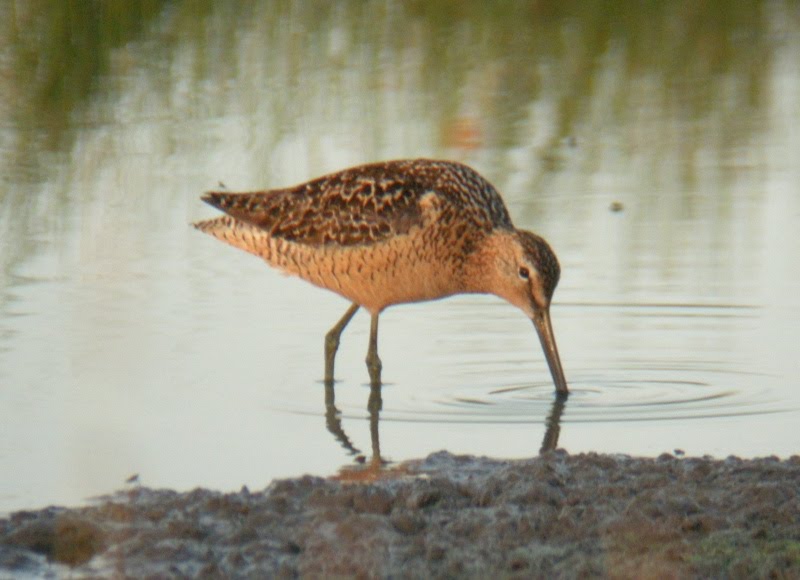
So not surprisingly, the first time I have ever seen a summer adult away from Mouillee was yesterday at the Caledonia Sewage Lagoons. I had been hoping to add Short-billed Dowitcher to my Kent Co. list and thus was happy to notice a single dowitcher as we (Curtis Dykstra and I) arrived. I assumed that since something like 99 out of 100 Michigan dowitchers are Short-billeds that that was what I had. However, despite my efforts I could not make it such. First off, voice was clinching: the bird always gave single, repeated, and well-spaced "keek" notes, each a high pitched whistle (at roughly 9, 13, 14, and 15 seconds into the clip).

On a couple occasions, as it flushed and flew around with 100+ Killdeer and 10 Lesser Yellowlegs, I heard other variations: once it gave a 2 noted "Kek kek"(exactly matching the note at 0:05 into the Stokes eastern track for this species), and once a flustered burst of similar notes, not at all like the clear "tu-tu-tu" notes of Short-billed Dowitcher. Both of these variations are acceptable for Long-billed Dowitchers.

Now to plumage and structure. The bird was long-billed (making it a female, which is also parsimonious since females leave the breeding grounds before males, as soon as the chicks emerge), and long-legged, with a tall, arching back and the "swallowed a grapefruit" body that Kevin Karlson et al. have made famous.
Its upperparts were relatively dark, though not as dark as many other specimens and wild birds I've seen.
Its underparts displayed the classic Long-billed condition: horizontal, thin, bars on the tips of the lateral breast feathers, moderate spotting across the middle of the lower neck/upper breast, and no markings at all on the middle of the lower breast and belly.
The tail was rarely visible (the predominant feather tract showing here is actually the uppertail coverts, not the rectrices themselves). But if you look carefully just beyond the end of the uppertail coverts you can see the tops of the middle rectrices, and that they have wide black bars and thin white ones. This trait is supportive, not diagnostic, as confirmed by my own specimen review and the literature.
The tail is visible here, slightly, as well, and you can also get a good feel for the bill shape, which Karlson et al (the Shorebird Guide) use to separate the dowitchers but I am still working out.Finally, it is worth noting that this bird was NOT missing any flight feathers. This is not surprising, because these birds are molt migrants, who select out a very small percentage of the wetlands on the landscape for molt, in Michigan including only Nayanquing Point (formerly) and Pointe Mouillee (formerly and currently). Other than that, molting sites in the eastern US are rare, limited mainly to Ottawa NWR and surrounding wetlands in NW Ohio, and Bombay Hook DE. The fact that this bird stopped in Michigan at such a small site makes me hypothesize that it is more likely to be of the latter group, otherwise why wouldn't it have just flown the extra 150 miles to get to Ottawa NWR and start molting? In any event, such a bird would not be expected to molt flight feathers as it is actively migrating, which is supported anecdotally by this individual. Very likely, once it arrives at its molting destination in another few days to week, it will immediately drop its innermost 3-6 primaries.

Wednesday, June 23, 2010

A rare Kent Co. Least Bittern

For some spoiled birders (Berrien County birders come to mind [Smith lakes]), this may seem trite, but for me seeing and hearing a Least Bittern is a rare treat. Even more challenging has been trying to add this rare species to my Kent County list. I have been scoping habitat on Google Earth now since early May, looking for suitably large cattail wetlands with pockets of protected coves with small openings. I have found several longshot candidates (and at least one good one) but so far all of my 10+ attempts have been fruitless. Until tonight. After hearing about the US Fish and Wildlife Service's new National Wetlands Inventory, which allows users to see the exact distribution of wetlands across the country using Google Earth, I found such a place. It is called Muskrat Lake and it is in the east central portion of the county near Grattan. tonight I put the boat in to give it a try. At the SW extension of this lake is a small, protected cove lined with cattail and what I believe to be Whorled Loosestrife:
And other portions lined with cattails:
I pulled in as it became overcast with a threat of thunderstorms, and was instantly surprised to hear a singing Least Bittern right about 8:10PM (watch the end of the clip for the bird to fly):

After some waiting the bird finally perched in the open, but the light was so bad I couldn't get a better picture than this:

Anyway, this serves as my 207th Kent County species, and is only the 9th time I've ever observed the species, and the second time I've heard it sing. Absolutely priceless.


Sunday, May 23, 2010

One of those days (and weeks)

So, after a Cinnamon Teal was found yesterday at Pointe Mouillee (at a time when my family had arrived from across the state, thus my inability to chase), I was hopeful upon arriving at first light that the bird had not moved on. Mike Overway and I arrived at the same time and began biking the dikes to the teal spot to begin our search. However, we were interrupted by this sound a short distance from the dike:


This being a species I've never heard sing in person (the time in FL as a 8 yr old doesn't count!), and never seen (the adult, that is- my state bird being a downy juvenile at Maple River SGA in Aug 1998), I had to stop and spend some time with this bird. After some waiting and listening to its intense singing, it eventually emerged, swum across an opening, then flew to the dike and walked across the dike I was walking on:The only way to describe this experience is that it was one of the most memorable ones I've had in a long time. I have waited a LONG time to get a good look at this species, and the payoff was immense.

So, finally we pulled ourselves away from this bird and began our Cinnamon Teal search. For the first 30 minutes the bird was not present, and then, it appeared in flight from the middle of Long Pond and landed not far from us, but in horribly backlit conditions in zone 3:
It then flew low to the northwest, into the interior of the Nelson unit, where we could not see it at all. After another 5-10 minutes it again appeared in flight, heading southeast back into the interior of the Long Pond unit where it hid apparently for much of the day. When it retires to this area, the bird is absolutely not visible from any vantage, so chasers will have to be patient. We again had the bird briefly in flight around 11:30AM and lost it again in the middle of Long Pond.

To cap off this incredible day, instead of having to chase my state Kentucky Warbler in Berrien County, right as I was getting ready to leave Mouille for the daunting trek, I received word of a new Kentucky in Hillsdale County, much closer. I arrived on the spot at 1:30PM and had my fourth state bird of the week! Here are the final two state birds (the Purple Gallinule from Tuttle Marsh on May 15 and the Western Kingbird from Tawas Point on May 16):What a day, and what a week it has been! This is the kind of stuff that keeps us birders going...